 ShareX
PowerPass Introduction
Turning Every Revenue-Generating Device into a Verifiable On-Chain Asset
Subway stations, convenience stores, shopping malls, restaurants, KTV lounges, community corners — you pass by countless shared devices every day: power bank cabinets, vending machines, lockers, scooters, battery-swap stations. These "quiet earners" interact with people constantly, generating steady, measurable cash flows. Yet, they've never truly been open to ordinary individuals.
This is the fundamental challenge faced by nearly all unmanned commercial devices within the sharing economy: you can use them, but it's nearly impossible to participate in their value distribution in a fair, transparent, and verifiable way.
The Dilemma of the Sharing Economy
Over the past 15 years, the sharing economy has gone mainstream with platforms like Uber and Airbnb. At its core, the model is built on a few key principles:
- Reuse of idle assets or underutilized time slots.
- Clear separation between usage rights and ownership rights.
- Users pay for access, while owners earn returns from asset ownership.
- Success depends on drastically improving matching efficiency and reducing fulfillment costs.
The true value of sharing lies in increasing utilization and turnover of existing assets, delivering more with less. Viewed through the lens of macroeconomics, microeconomics, or ESG and sustainability, the sharing economy is one of the most efficient ways to organize resources. In today's global context, it not only aligns with economic efficiency but also with sustainability imperatives.
But while the concept is sound, many so-called "sharing economy" models today look more like platform-based rental economies. Common issues include:
- Centralized asset supply: Platforms or brands control procurement, deployment, and operations.
- Opaque data: Pricing, orders, and revenue distribution are black boxes, controlled solely by the platform.
- Wasted assets through competition: Scale is pursued by endlessly adding new assets instead of revitalizing existing ones.
These problems inevitably harm efficiency and drive up costs. Solving them is exactly where blockchain and Web3 can shine.
ShareX's Exploration: PowerPass as a Consumer-Grade RWA
The issue with the sharing economy isn't lack of value — it's poor value distribution. To give value back to those who create it, we need a new asset paradigm.
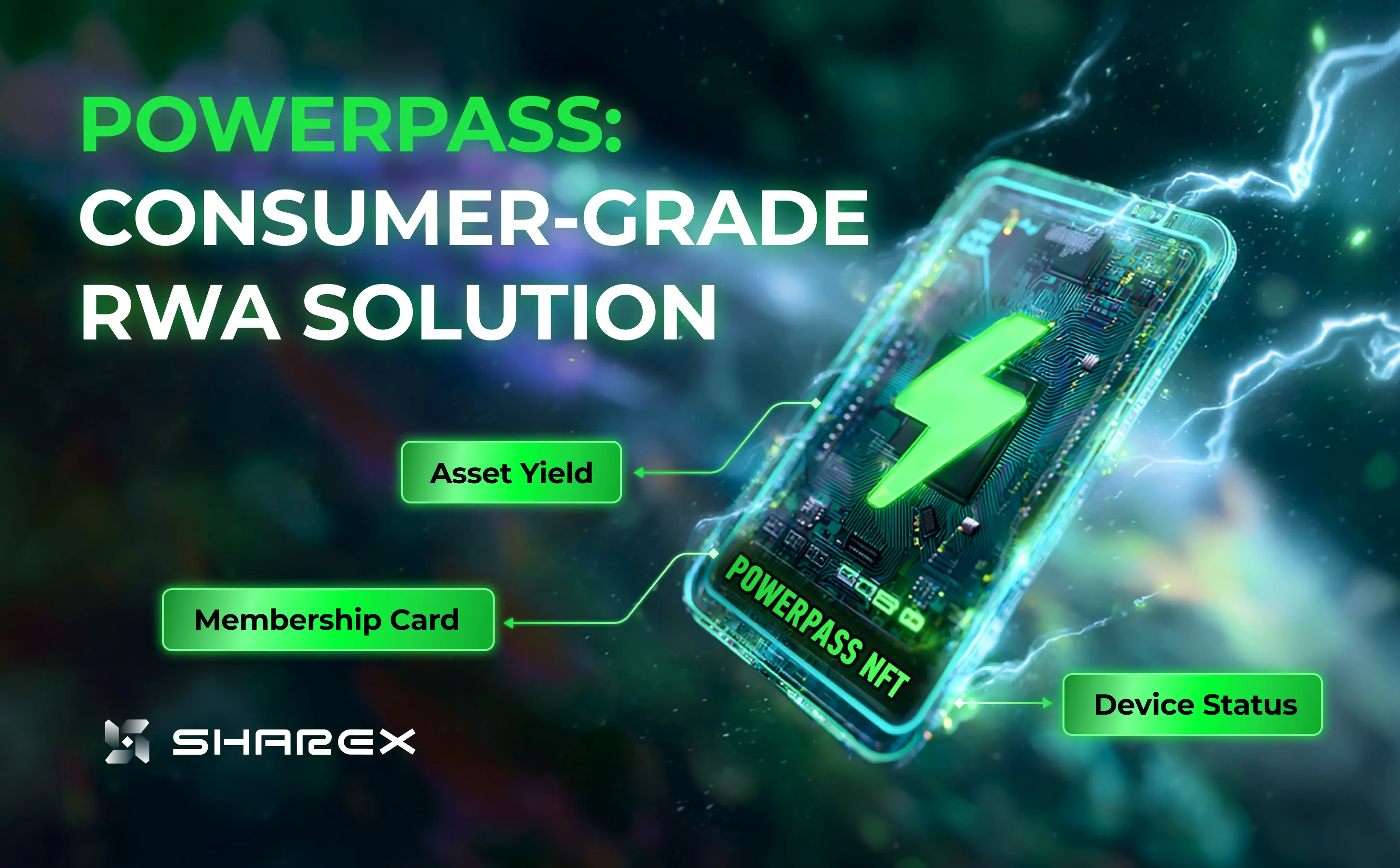
ShareX calls this Consumer-Grade RWA. It has two layers of meaning:
- "Consumer-grade" pricing Unlike large RWAs such as government bonds, real estate, or public equities, consumer-grade RWA focuses on long-overlooked micro-assets: a single vending machine, one power bank, a scooter, or a single battery-swap station. They're visible in daily life, generate measurable cash flows, can be bundled, and are priced within reach for ordinary people. This layer has long been ignored in traditional RWA narratives.
- Dual nature: both investment and consumption By packaging rights into NFTs, consumer-grade RWA merges off-chain Web2 utility (usage or even ownership) with on-chain RWA yield (income rights). When you use it yourself, it's consumption; when you open it up to the network, it becomes investment. This perfectly mirrors the original logic of the sharing economy.
PowerPass is ShareX's first consumer-grade RWA product, built around shared power banks and supported by real devices and operations from PowerNow (a Deshare Alliance member) in Japan.
- From the investment perspective: Each PowerPass NFT maps 1:1 to a real deployed asset (a physical power bank). Every use, return, or rental triggers verifiable on-chain events and distribution. What you see isn't just "screenshots and reports," but auditable revenue flows.
- From the consumption perspective: It's like buying a power bank outright, plus receiving a one-year membership for unlimited swaps. You can use it as you always would — or temporarily return it and let it generate shared revenue for you.
PowerPass doesn't just "put receipts on-chain." It faithfully restores the core logic of sharing — making distribution verifiable. In essence: a one-time device buyout + offline usage rights + shared RWA yields.
From Consumer-Grade RWA to an On-Chain Micro-Asset Network
The innovation of PowerPass becomes clearer when compared with existing paradigms:
- Versus DePIN: Instead of starting with supply-side incentives (coverage / compute → rewards), PowerPass begins with real usage events and clears cash flow directly to user wallets.
- Versus traditional RWA: Instead of slicing large assets top-down, it builds bottom-up with measurable micro-units, bridging the "last mile" between big assets and individual participation.
- Versus asset financing: Instead of centralized receivable-driven financing, it turns "finance–operation–distribution" into verifiable on-chain clearing, down to single-device, single-order, single-timeslot granularity.
Once PowerPass connects consumption ↔ sharing and revenue ↔ distribution, the next leap is to network devices into a broader system. Through the Deshare Protocol and RWA tokenization standards, ShareX upgrades each device into:
- An on-chain entity: With its own data stream, asset ID, and yield structure.
- A liquidity unit: Splittable, tradable, collateralizable, and integrable into larger financial structures.
- An on-chain behavior gateway: Linking users, locations, and habits — bridging IRL and Web3.
Devices aren't just assets — they're the neurons of an asset network. When thousands connect via shared event models, the network reveals three core traits:
- Programmable: Distribution, rates, limits, and priorities expressed in contracts, executed automatically.
- Composable: Cash flows across cities, asset types, or timeframes can be repackaged by risk/tenor.
- Auditable: From "who used it when and where" to "how revenue was distributed," everything is verifiable.
This means you don't just own "the future of one device." You could combine, for example, 8 power banks around a mall + 4 vending machines at a subway station + 2 locker units in a nightlife district into a single cross-scenario cashflow product, priced and risk-managed by real usage curves.
Isolated assets can only be traded. Structured asset networks can be valued. This isn't just DeFi composability — it's behavior-driven infrastructure investing, something even traditional infra can't provide.
This is Just the Beginning
PowerPass doesn't turn "RWA" into a buzzword — it brings it back to everyday life. The first batch of PowerPass is coming soon. In partnership with PowerNow, we're bringing real shared devices on-chain as RWA.
- Every real usage becomes a visible, trackable, fair value distribution.
- Every day, people can access offline physical growth with affordable thresholds.
- The sharing economy returns to its essence: higher matching efficiency, lower fulfillment costs.