 ShareX
Deshare Protocol
At the center of the Deshare architecture lies Deshare Protocol — the core on-chain trust engine that defines and anchors the "minimum verifiable facts" of the physical world.
It functions as a decentralized state machine that records, verifies, and settles real-world events — turning each device action, payment, or data update into a cryptographically provable on-chain state.
Core Functions
- Identity & Ownership: Registers decentralized device identities (DIDs) and binds them to verified brands or operators, establishing an authenticated chain of ownership.
- Data Proofs: Anchors event, usage, and payment data via Merkle roots, hashes, or CID pointers, following a versioned schema to ensure data integrity and evolvability.
- Settlement State Machine: Encodes financial and operational logic — including revenue collection, distribution, reconciliation, and correction — as verifiable state transitions on-chain.
- Privacy & Selective Disclosure: Ensures truth is on-chain (state + proof), while raw data stays off-chain (plaintext + logs), balancing transparency and privacy.
In essence, Deshare Protocol transforms trust itself into a programmable asset — enabling data, identity, and economic activities from the physical world to be verified, shared, and monetized across Web3 ecosystems.
PoPW: Proof of Physical Work
PoPW is a mechanism that verifies physical work-based contributions to assess value and rewards. It is widely adopted across various DePIN projects. For Deshare Protocol, accurately and reliably collecting operational data from different shared economy brands and measuring their contributions to the network is crucial. ShareX utilizes PoPW to scientifically evaluate contributions based on the real-world service activities of its shared devices.
The diagram below illustrates the business logic of ShareX PoPW:
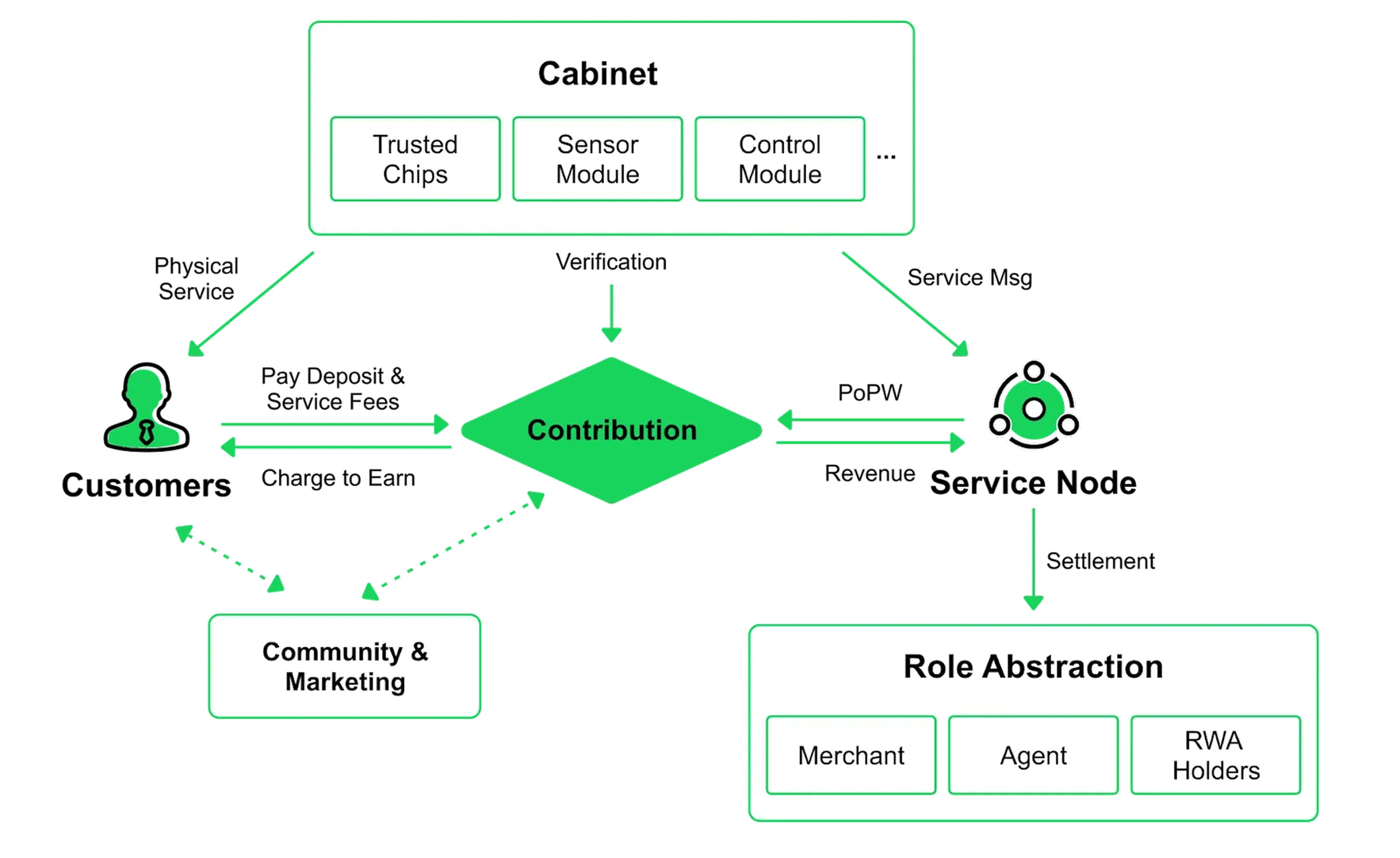
Business logic of ShareX PoPW
- Consumers interact with shared devices, generating real-world physical services. During this process, they contribute to the network by paying deposits or service fees.
- Shared devices, equipped with IoT communication capabilities, package the service data and generate PoPW proofs, which are submitted to the network for validation.
- The network processes both:
- Financial transactions, handling deposit refunds and service fee settlements.
- Contribution assessments, evaluating PoPW data to fairly reward participants in the service ecosystem.
In ShareX, the PoPW process consists of the following four steps:
- A registered shared device under Deshare Protocol provides real services to users in offline spaces, such as renting a power bank or completing a vending machine purchase.
- The device packages and signs physical work data (e.g., device status, order data) according to Deshare Protocol requirements and sends it to the IoT oracle.
- The IoT oracle verifies the device DID and the signed PoPW, then submits the validated PoPW to the blockchain smart contract.
- The smart contract parses the parameters to evaluate the workload and contribution of the PoPW, rewarding the service providers accordingly.
In essence, Deshare Protocol transforms trust itself into a programmable asset — enabling data, identity, and economic activities from the physical world to be verified, shared, and monetized across Web3 ecosystems.